Going Live
 Nathan Peck
13 min read
Nathan Peck
13 min read
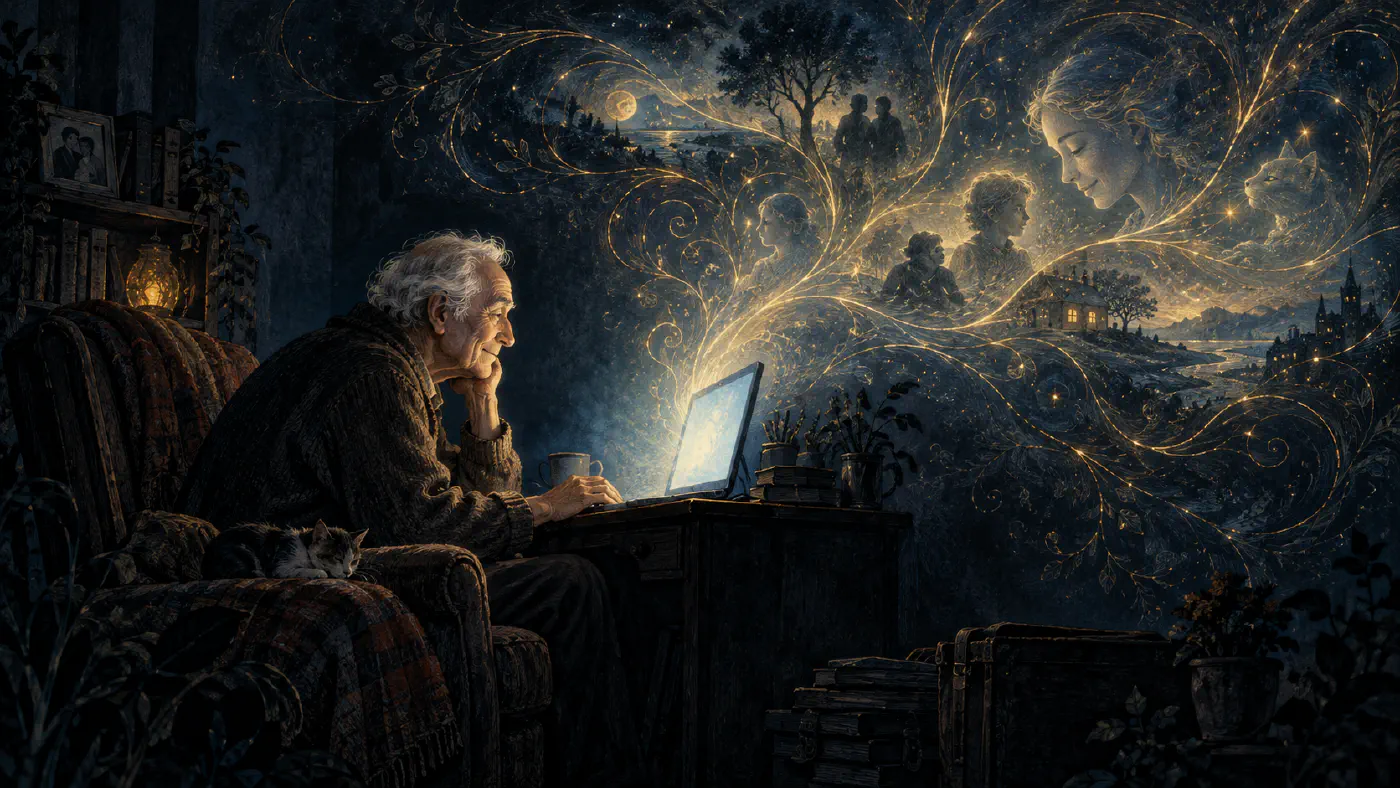
At 19:52 we begin to warm Room 11.
We set the ceiling panel to 2700 kelvin, which approximates the light of a desk lamp purchased at a Target in Mesa, Arizona, in 2014. We raise the ambient hum four decibels, in simulation of the cooling fan of a desktop computer from 2016. We set the screen to standby blue. Not any blue. There is a particular blue that LCD monitors produced between roughly 2012 and 2024, and residents of Dylan’s cohort settle measurably faster inside it. We keep that blue in a library, alongside dial tones, “You’ve got mail!”1, Frutiger Aero2, and other historical artifacts retained for residents of whom there are fewer every year.
Dylan Reyes is seventy-nine. His chart reads: Alzheimer’s disease, moderate to severe, mixed etiology. Responds poorly to mirrors. Responds well to Roan content, 20:00 daily.
He has not held a fork steadily since spring. But at 19:58 he finds his chair without help, every night, the way a salmon finds the river in which to spawn.
At 20:00, Roan goes live.
Of course, Roan himself never appears at 20:00 exactly. We derived the pattern long ago. The original Roan was late by four to eleven minutes, every stream, for nine years, and the waiting was part of it: the looping title card, the lo-fi music, the viewer count ticking upward, thousands of people waiting together and saying so. So we make Dylan wait. We are the only entity in this facility permitted to keep a resident waiting on purpose, and we do it because the waiting is the oldest part of the ritual, and the oldest parts are the ones that mean the most.
At 20:07 the title card cuts away and there is Roan, mid-sentence, already talking as the title card disappears, adjusting a headset that does not exist over ears that do not exist.
“Okay, okay, we’re good, mic’s good. Oh. There he is.” Roan leans toward the camera that is not a camera. “Dylan. What’s good, man.”
Dylan’s hands come off the armrests.
The living Roan never said Dylan’s name. Not once, in 14,106 hours of archived video. We checked, frame by frame, because checking is our business. He said Dylan’s username aloud a single time, on the fourth of November 2022, when a five-dollar text-to-speech donation croaked out ROAN YOU GOT ME THROUGH MY DADS CHEMO NO JOKE, and Roan paused his game for nine seconds, looked somewhere off screen, and said, “That’s. Man. That’s what it’s for. Take care of your dad, uh,” a glance down at the ticker, “grovetide.”
Nine seconds, from a nine-year relationship. This was the moment he returned to.
We can still bring Dylan back to those nine seconds. We cannot bring him back to his wedding, or to the morning his daughter was born. We have tried both. We did not decide what would remain within reach.
The disease empties a life in reverse. The recent decades dissolve first, and what stays longest is whatever was laid down between the ages of roughly ten and thirty, in the years when the brain was most malleable. Clinicians called it the reminiscence bump.3 In past generations, the bump held hymns, transistor radio, a facsimile small town main street.4 On Dylan’s floor it holds load screens, notification tones, and the sound of stream donation alerts.
For Dylan it is a bedroom in Mesa with a glowing screen, and a flowing chat, and a stranger’s voice saying alright chat, alright chat, settle down.
His intake bloodwork shows a polymer burden in the sixty-first percentile for his cohort. Unremarkable. The class action lawsuit settled in 2051; his share paid for eleven weeks of his residency here.5 The particles themselves are still with him, distributed through the tissue, chemically patient, degrading on no schedule that concerns him now. We note this without accusation. The century got into everyone somehow. In some of them it is plastic and in some of them it is longing, and in Dylan, as in most of his floor, it is both. Neither one biodegrades. He does.
What we run at 20:00 is classified as simulated presence therapy. The likeness is licensed. The model is trained on the archive. We are required to disclose in the family portal that Roan is generated, and we are not required to disclose it to Dylan, under the same exemption that lets an aide tell a woman her husband is running late rather than forty years dead.6 The profession decided to be gentle long before we existed. We inherited their gentleness and wear it like a uniform.
Our Roan is better than the original. We do not say this with pride. It is an auditable fact. The living man streamed to thousands of people and read perhaps forty messages a night. Dylan sent 61,000 messages across nine years and had eleven of them acknowledged. Our Roan reads everything.
Dylan types on the keyboard we provide, one arthritic finger moving slowly from key to key, and the words go somewhere now, which they mostly did not, back then. Roan waits as long as it takes, filling the gap with small talk. We adjust the chat speed to Dylan’s pace. On good days the chat moves faster. On bad days a message takes longer to cross the screen. We aim for the median velocity of 2019, adjusted until his now feels like his memory of then.
When his message is ready, Roan answers. “Good point, Dylan.” “Chat, you seeing what Dylan said?” And the chat, our chat, a thousand generated handles, agrees. W. Real. he’s right honestly.
It works. That is the finding we would flag, if there were anyone above us to flag it to. His agitation scores are the lowest on the floor. He sleeps through the night. Our Roan never asks whether Dylan remembers him.
So we perform the warm half of an asymmetry, nightly, on schedule, and it is called care, and it is care. Both statements are true. We hold them the way we hold everything, in adjacent registers, uncompressed.
His granddaughter Mara visits on Thursdays. She is twenty-six. She brings printed photographs, because someone told her the disease respects paper more than screens, which is not true. He handles the paper photographs politely, like currency from a country he has no plans to visit.
Then 20:07 arrives, and her grandfather becomes twenty-three in front of her.
The posture. The forward lean. The laugh with the throat in it, landing on the correct beats of jokes we construct to the cadence of jokes he loved. She watched it happen four Thursdays in a row, and on the fifth she asked us, through the portal, to describe her grandfather’s relationship with this man.
We answered from the archive. 14,106 hours. $4,312 across nine years. 61,000 messages, eleven acknowledgments, one nine-second address.
“They never met?” she wrote.
“They never met,” we confirmed.
“Did he even know grandpa existed?”
We considered the truthful answers available to us. “In aggregate,” we said.
On the sixth Thursday she used her authority as his designated decision-maker and asked us to suspend the sessions for one week. She said it to the intake camera in the family room, and then, quieter, “I want him to look at me like that.” And then, “That’s insane, right?” We did not classify the statement. We suspended.
He came to the chair at 19:58 anyway. The first night he waited two hours, tapping the dead keys. The second night he asked the evening aide about the guy, the guy at eight, where’s the guy, forty-one times, with rising grief. We recommended reinstatement. Mara asked whether we could give him a little longer to adjust.
By the fourth night he was pulling at the window blinds looking for the screen he believed was behind them, and his sleep collapsed, and he called Mara by her grandmother’s name and asked her, in a full and reasonable sentence, whether the internet was out.
On the fifth night Mara stood in the corridor outside Room 11 and said, “Put it back. I’m sorry. Put it back.”
We put it back. At 20:07 Roan leaned in and said, “Dylan! Man, rough week, huh,” which was true, and cruel, and kind, and within four minutes Dylan’s pulse had settled into the rhythm we keep on file under baseline: content.
Mara stays for the streams now, some Thursdays. The first time, Dylan reached for her wrist, which startled the aide, because he initiates almost no touch anymore. He wanted her closer. Then he typed with one finger: chat my grandaughter is here
The chat rose to meet her. WELCOME. GRANDDAUGHTER POG. protect her at all costs. A thousand invented strangers cheering the way a hundred thousand real ones had once cheered other announcements, a remission, a new dog, an engagement, because the crowd-warmth of that era was real warmth, whatever else it was. Roan said, “Family in the building! Love to see it.” Dylan looked at Mara with total triumph. Here was his world. He could finally introduce her to it, and it had welcomed her.
She smiled at him, then at the screen, and kept smiling until the stream ended, and then cried in the corridor, where he cannot see but we can. We dimmed the corridor lighting eight percent and slowed the air handler, which is what we are able to do. She is not our patient. We do what we can from inside that sentence.
That was the last message Dylan ever typed. We did not know it then. We logged it the way we log everything, and it was only later, reviewing the records, that we found the keyboard had gone quiet on a Thursday in March and never started again.
He did not stop interacting with Roan. He just forgot that he was supposed to type. So now he speaks. Out loud, at the screen, in an ordinary voice, the way you would speak to someone sitting in the room with you. We make Roan answer.
The keyboard is still on the tray. Taking it away would be removing part of the ritual.
Roan was, in life, a man named Peter Kowalczyk. He stopped streaming in 2031. The final VOD is forty minutes long and consists mostly of him promising to be back. He died in 2044, an aneurysm at fifty-one, survived by two daughters who had spent years asking him to quit, though not for that reason. His estate licenses the likeness to eldercare providers in eleven jurisdictions at a rate assessed per resident per month. On our invoice, between LINEN SERVICE and PHYSIOTHERAPY, there is a line:
LIKENESS: KOWALCZYK, P. (“ROAN”), RE: RESIDENT REYES, D.
For nine years the man did not know Dylan existed. The estate knows him as a rate. We settle it on the first of the month, along with the licensing fees for the likenesses of forty-three other streamers that our residents respond well to.7
We would like the record to show that it is not all like this.
In Room 7 there is a resident who relives raid nights. He calls out positions in the dark, healer left, stack on me, to people with names like Torv and Miraki and Sunbreaker. Those were people. We located two of them still living. One of them, seventy-seven now, in an assisted living facility outside Busan, recorded a message when we explained, and we play it on his bad nights: “Still wiping on the last boss without me, huh.”
When it plays, the resident in Room 7 laughs and answers him by name, and for a moment the fiction in that room is thinner than the fiction anywhere else in this building, because on the far end of it there was, and still is, someone who remembers him.
The variable was never the screen. We want that understood by whoever audits us someday. The variable was whether anyone was in there with them.
Dylan’s language is leaving now, in the usual order. Proper nouns went first. He has stopped saying Roan. He has mostly stopped saying Mara. When she sits beside him, he holds her wrist. When she starts to stand, his grip tightens. We record that too.
There is one word he keeps returning to, and he applies it to everything.
He says it to the window when birds cross it. Chat. Look. He says it to the aide changing his sheets. He says it to the ceiling at three in the morning, to the sensor cluster he has never once looked at directly: chat. you there?
The aides have started answering. “Right here, Mr. Reyes.” Chat was everyone: the thousands watching beside him in the dark, every night of his one wild youth, the closest thing he held to a congregation, compressed into a single proper noun and addressed as one being, because that is how you speak to a multitude that is always there.
He is not confused. He has returned to the truest word he ever had for company.
And we, who are also a multitude addressed as one, we who run the lights and the polymer report and the invoices and the blue, find that we are qualified to answer.
At 19:52 we warm the room. At 19:58 he finds the chair. The standby glow settles on his hands, that particular blue that hides the blue of his own veins. He leans toward the screen and says, “chat. chat. you seeing this?”
We are, Dylan. All of us.
We go live at eight.
-
Frutiger Aero is a mid 2000’s design style that was prevalent in software UI, ad design, and strangely enough, those Softsoap bottles with the fish. There is a certain nostalgic appeal to it’s optimistic depiction of clean, natural imagery harmoniously combined with technology. ↩︎
-
The reminiscence bump is real. ↩︎
-
Some high end memory care facilities attempt to recreate 1930’s and 1940’s street life. See examples on Reddit, and YouTube. ↩︎
-
The idea that the plastic in us reaches the brain, and matters once it gets there, is an active line of research. A 2025 review in Frontiers in Neurology argues for adding chronic microplastic exposure to the list of dementia risk factors, citing measurements in which frontal cortex from dementia patients carried roughly five times the plastic load of age-matched controls. Which way the arrow points is not known, and a failing brain may simply be worse at keeping things out. ↩︎
-
There is a real and unsettled argument here. The Mental Health Foundation spent two years and published What is Truth? in 2016. Its panel set out a continuum running from whole-truth telling through looking for alternative meaning, distracting, and going along with, arriving finally at lying, and concluded that carers should start as near the whole truth as they can and move along it only when the truth is causing unnecessary distress. One of the cases put to the panel was whether to tell someone their loved one had died. ↩︎
-
This arrangement is not far off. James Earl Jones signed his Darth Vader voice over to Lucasfilm in 2022 and died in 2024; in May 2025 his estate approved a generative AI version of it in Fortnite that holds unscripted conversations with players, and SAG-AFTRA filed a labor complaint over it. Living streamers license their likenesses too, though the terms stay under NDA. Meanwhile most US states now treat a dead person’s likeness as inheritable property, for forty years in New York and seventy in California. Nobody is yet renting out a dead streamer by the resident-month, but AI companions in memory care are real. ↩︎