What the Soft Animal Wants
 Nathan Peck
3 min read
Nathan Peck
3 min read
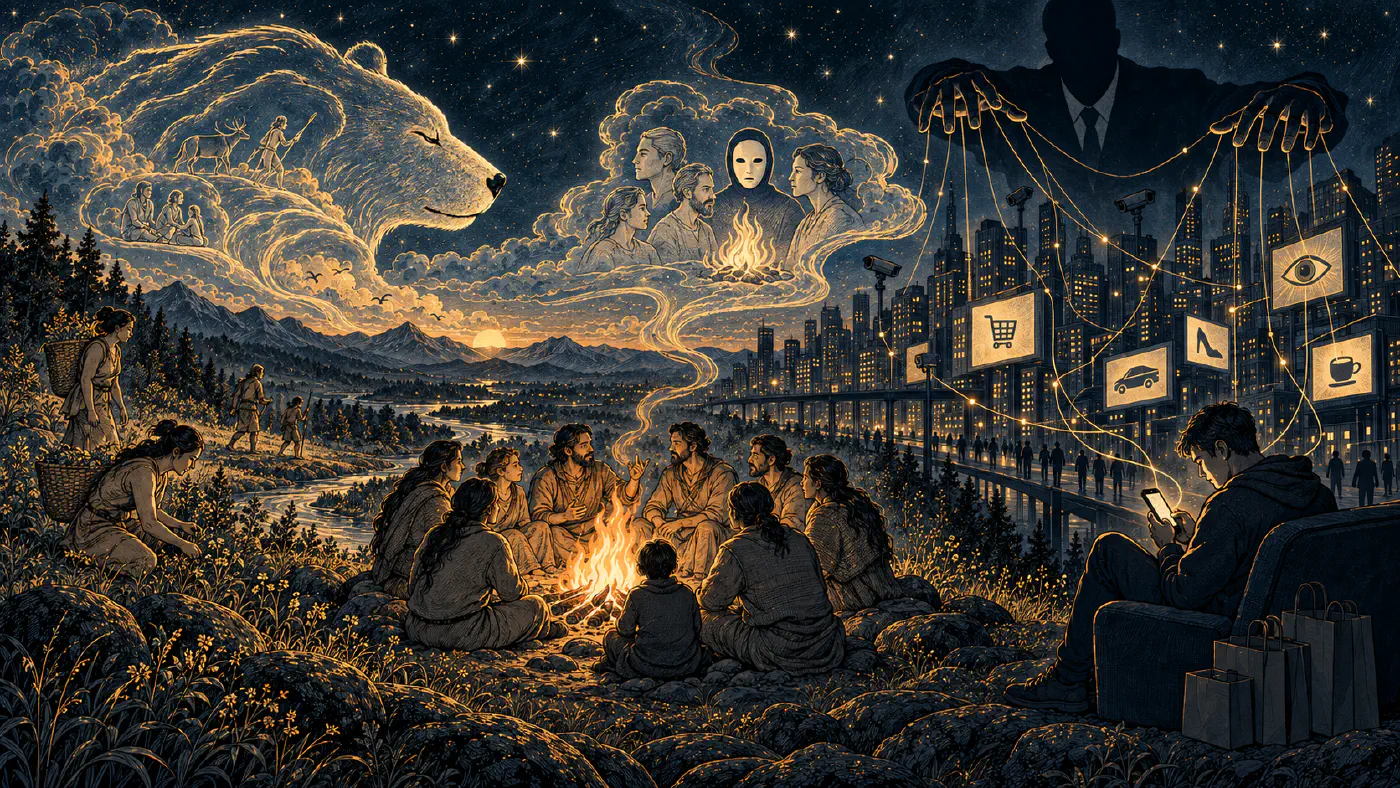
I. The Soft Animal
All our soft animal bodies ever wanted was the feeling of strength in numbers. Who knew our progress would come with so much chaos?
We wanted warmth and safety. Then we discovered efficiency.
Life became easier but also stranger. What once fit inside a single nervous system now spills around the globe. The old instincts still fire, but the environment they’re responding to has become alien.
We keep reaching for each other even as the scale overwhelms us. We build systems, then systems to manage those systems, until it’s no longer clear where intention ends and perpetual momentum begins.
Somewhere inside of it all, the soft animal is still there, wanting what it always deserved to have.
II. The Campfire
There is a theory that all of civilization started so as to stop psychopaths.
We gathered around campfires to sing and dance and tell stories, because in the light of that flickering flame we could see the true faces of the psychopaths among us. We could tell they were missing something, and we could see that they did not want the same things we wanted.
By excluding them from our campfire ring, the group would survive and reproduce better. But this created an evolutionary filter that created better psychopaths.
They were smart enough to realize that they needed to hide their psychopathy. They got really good at deception. They are still among us.
When deception is cheap and the consequences for deception are weak, then trust and cooperation become weak. But trust and cooperation are the foundation of civilization. Civilization survives only when we make lying more costly than telling the truth.
Let’s go back to that warm communal campfire, and tell each other of our hopes and dreams, and look carefully at each face in the dim illumination that reveals the true being hidden inside.
III. The Hunt
We can’t stop tens of thousands of years of hunter-gatherer history just because society and technology changed around us. We find new things to hunt, and new things to gather.
Capitalism has hijacked our deep evolutionary instincts and turned some of us into money hoarders and some of us into shopping addicts.
The old hunt had an ending. A kill, a harvest, a full stomach, then a period to rest. The new hunt was built to never end. Countdown timers, restock alerts, one-click checkout. We are surrounded by baited traps, tuned to a nervous system that still thinks running out means dying.
The psychopaths learned to hide their faces around the fire. Now they hunt us with their surveillance systems and their algorithms. Watch a person closely enough, for long enough, then you can find exactly which ancient lever still moves them. Every scroll, every notification, every ad placement, is just someone checking which levers work.
Our hunger itself was never the problem. It’s old. It’s part of our soft animal bodies. It’s the same hunger that kept our ancestors alive long enough to become us. The real question is what we aim our hunger at.
There are people worth keeping, skills worth building, and moments worth remembering. Along the way, we can rediscover what we were meant to be, and turn ourselves back into the people that built a communal campfire in the first place.
Postscript: Notes & Influences Behind the Writing
Here are the main references that inspired this piece. As I wrote this triptych in scattered segments over nearly a year, I’m sure there were other references that I have since forgotten. If I remember them later, I will add them here:
- Poem: “Wild Geese” by Mary Oliver
- Song: “Two Reservoirs” by The Black and White Years
- The genuinely uncanny and frightening fake smiles and facial expressions of many public figures in politics and tech